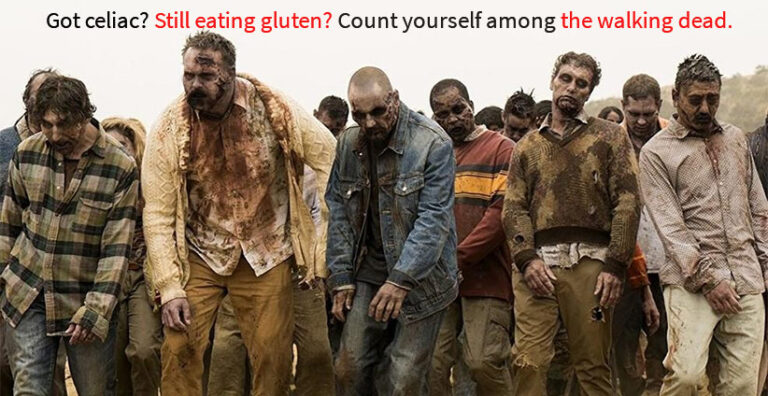
Celiac disease is serious sh*t. I know that. You know that. You know who doesn’t know that? EVERYONE ELSE. And why?
Because of Jimmy Kimmel, who made gluten-free people look idiotic.
Because of Dr. Oz, who called gluten-free a scam.
Because of the ridiculous Kardashians, who jumped on (and off) the bandwagon.
Because of Jimmy Fallon, who consistently has made us the butt end of his lame jokes.
Because of Party City, who called us gross.
Because of the Today Show, who said celiac is the new “trendy disease.”
Because of Elle Magazine, who said we live in a bubble.
Because of Joy Behar, who called celiac disease a “bunch of baloney”.
(Dude note: The above was a painful walk down memory lane. And I just touched the surface. Sigh.)
And yes, because of the medical community, who continue to under-diagnose and misdiagnose our wonderful little autoimmune disease.
Why do I bring all of this up? Because of an email I received recently from a son whose dad almost died of celiac disease, yet will not stop eating gluten. Here’s the email:
However, my father has not been taking this diagnosis seriously. He is the type of person who likes to eat whatever he wants, whenever he wants, and scorns anything that is not traditional food. I have tried to bring him gluten-free snacks and food, take him to gluten-free bakeries, and show as many options as possible. I have talked to him about the potential health implications of ignoring the gluten-free diet, such as cancer or having the severe anemia come back. But he is flippant and says that if the anemia comes back he can just go back to the hospital and have more transfusions.
I don’t know if he has symptoms or how severe they are, but he also has had diabetes and insomnia his whole life, so if he has any digestive issues or weakness he attributes it to those, so he doesn’t realize that celiac could be affecting his life. The other day, he wanted to go to IHOP for an omelette, but ended up ordering pancakes and french toast.
While we were there, I had a serious discussion about him about the implications of not following a gluten-free diet with celiac disease, and he told me he would start taking it seriously. But the following morning, I found biscotti wrappers and an empty cake tin and an empty packet of roti. Last night, I ordered a gluten-free pizza, but he insisted he had to have beer with pizza and went out to get beer, despite my attempts to come with him and find a gluten-free beer. (There weren’t any at the local supermarket and he wouldn’t go anywhere else; I’m also 19 so I can’t buy it for him.)
I believe not liking gluten-free food is a mental thing for him. I think he thinks any specialized diet is weird and that their food is disgusting: for years before this I’ve been vegan, and he always loves the baked goods I make until I tell him it’s vegan, and then his mind immediately flips. Similarly, he hears the word “gluten-free” and immediately assumes in his mind that it’s less than and that it is disgusting, like “oh this is okay, for being gluten-free.” Sometimes I understand it: I try the food he has and I can see that some of it is not the same. But the majority of it is completely a mental thing.
I brought home gluten-free brownies from a bakery and I tried one and they tasted exactly like any other brownie I’ve had in my life, chocolaty and delicious and the texture was the same. However, to him it was awful. It’s just frustrating to me when he can still eat so much food that he loves: he can have steak and potatoes and rice and brownies and muffins, as long as the baked goods are gluten-free, and he can only see the negative aspect of life.
The solution is so simple and his life can stay relatively the same: instead of going to Panera Bread to have coffee and a bear claw, he can go to Organic Bliss and have coffee and a gluten-free pastry. But he doesn’t see it that way.
My question is, is there anything I can do to help convince him to take his disease seriously? Is there even anything else I can do at this point, or should I just leave him be? I don’t live near him, so I can’t monitor what he’s eating: as I’ve said before, even if I did, it wouldn’t help. He actually lives alone, so there’s nobody to check up on him except when I call. When he was hospitalized in May, it was the same day I was flying in to visit him, and if he had not made it to the hospital that day I would have come home and found him dead.
That image has scared me ever since, and when he doesn’t pick up I am so scared that something happened, because I know he leads a lifestyle that could contribute to his death. He doesn’t take his doctors seriously either. I understand that he’s an adult and he can make his own decisions, but as someone who cares about him, it just makes life really hard.
Do I need to just let it go, and when something more serious happens, he can decide whether eating gluten is worth it at that point? But if having a near brush with death doesn’t convince someone to go gluten-free, I don’t know what will. However hard I try, I can’t make the decision for him, and it just makes me sad when I sit across from someone who is eating something that may directly contribute to their death or major health problems in the future. I think over this trip, I’m starting to come to terms with the fact that I’ve tried, and if when I leave he reverts back to eating the way he used to and dies as a result, it won’t be my fault.
Thank you for reading my message. I’m sorry it is so long. Please let me know if you have any advice.
First…you are an amazing son and your dad should thank his lucky stars he has someone who cares for him so much. Perhaps if I cared as much about my dad’s health when he was overindulging, he’d still be here.
As to why he still insists on eating gluten, had he heard of the gluten-free diet before he was diagnosed? Did he think it was just a trend and not to be taken seriously, even if it affects your health? Perhaps he had some bias going into this. Or perhaps he’s just being stubborn and is set in his ways.
Here are some more facts you can try to throw his way:
- Fact: People with celiac disease (who do not eat gluten-free) have twice the death rate of those without the intestinal disorder.
- Fact: People with untreated celiac disease have a moderately increased risk of suicide.
- Fact: Patients with celiac disease are more likely to be afflicted with problems relating to malabsorption, osteoporosis, tooth enamel defects, central and peripheral nervous system disease, pancreatic disease, internal hemorrhaging, organ disorders (gall bladder, liver, and spleen), and gynecological disorders.
- Fact: Untreated celiac disease has been linked an increased risk of certain types of cancer, especially intestinal lymphoma.
Will any of these facts change your dad’s eating habits? I don’t know but I get the sense they won’t.
My suggestion? Show him this article. If nothing else, it will show him how far you are willing to go to help him. And if he still doesn’t listen? Leave him be. You’ve done what you can and the rest is on him. If god forbid something does happen to him, it is not your fault.
I wish you both nothing but the best.
GD


Leave a Reply